
Most Sydney tenants prepare for their final inspection by cleaning what they can see. They wipe down benchtops, mop floors, scrub the toilet, and leave feeling reasonably confident the property will pass. Then the agent walks in, opens the oven door, runs a finger along the rangehood, shines a torch at the shower screen — and the clean that felt adequate suddenly is not.
The gap between what tenants clean and what agents inspect is where most bond money is lost in Sydney. It is not a gap of effort. It is a gap of information — specifically, not knowing the exact sequence agents follow, the specific items they document, and the standard they are measuring against.
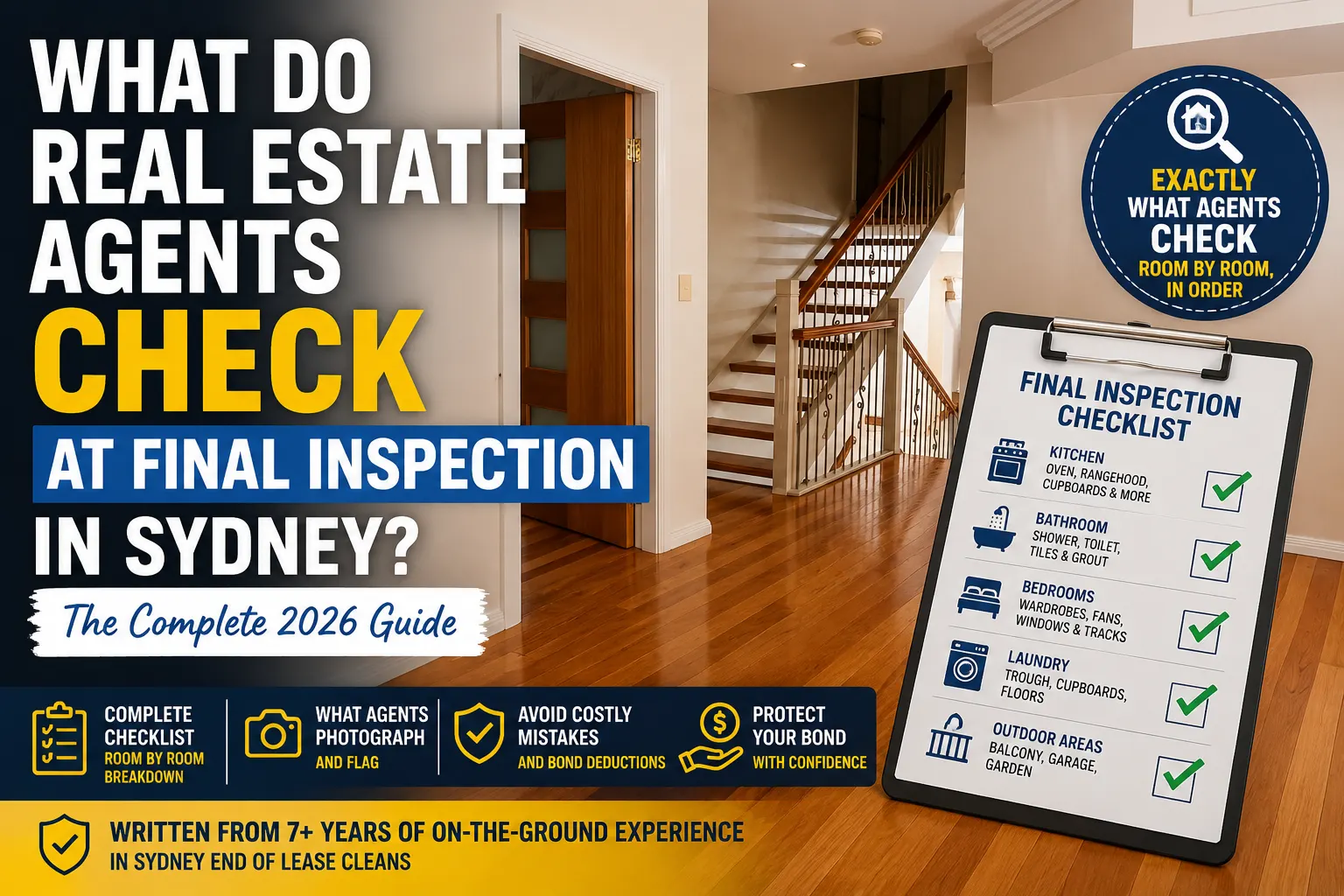
This guide closes that gap, covering what Sydney property managers check, flag, and photograph during final walkthroughs, room by room — and what consistently makes the difference between a full bond return and a dispute.
If you want a printable version of the full cleaning checklist our team follows on every job, it is available on our cleaning checklist page.
How Property Managers Conduct Final Inspections in NSW
Understanding the method agents use during a final walkthrough is as important as knowing what they look for. Sydney property managers are not randomly checking rooms — they are following a documented process that is deliberately designed to be legally defensible.
The Entry Condition Report Is Their Reference Document
Every final inspection in NSW is conducted by comparing the property’s current condition against the entry condition report completed at the start of the tenancy. This report — which should have been signed by both you and your landlord or agent when you moved in — documents the state of the property room by room, often with photographs.
The agent’s job at the final inspection is not to judge whether the property is clean by some abstract standard. Their job is to identify any difference between the current condition and the entry condition that goes beyond fair wear and tear. This is a critical distinction: you are not required to return the property in perfect condition — you are required to return it in the same condition it was in when you took possession, with allowance for normal deterioration from everyday use over time.
This is why your own entry condition report and any photos you took when you moved in are important documents to keep. They are your evidence if a dispute arises about whether a particular issue was pre-existing or attributable to your tenancy.
The Walk-Through Method
Property managers in Sydney typically conduct final inspections systematically. They move through the property room by room, usually starting at the front entrance and working toward the back or from the top floor down. Within each room they work top to bottom — ceiling fans and light fittings first, then walls, then surfaces, then floors — because this is the most efficient method and it mirrors the order in which a thorough clean should have been completed.
They photograph everything they intend to flag. A modern final inspection report in NSW includes timestamped photos of any identified issues, which become the basis for a bond claim if one is made. An agent who walks through without photographing issues will find it very difficult to support a bond deduction later. An agent who photographs ten items has ten documented claims.
What “Reasonably Clean” Means Under NSW Law
Under the Residential Tenancies Act 2010 (NSW), tenants must return the property in a “reasonably clean condition having regard to its condition at the commencement of the tenancy.” Reasonably clean does not mean sterile, freshly painted, or brand new. It means cleaned to a standard consistent with how the property was presented when you moved in, accounting for fair wear and tear.
What it does not mean is what most people consider “everyday clean.” Reasonably clean in the NSW tenancy context means professionally clean — surfaces free of built-up grease, mould, limescale, and staining; floors vacuumed and mopped; all appliances clean inside and out; windows and tracks free of debris. The gap between everyday clean and reasonably clean in the legal sense is substantial, and it is this gap that generates most bond disputes.
Under NSW law, a landlord cannot force you to use a specific cleaning company, and cannot require the property to be cleaner than it was at the start of the tenancy. If the entry condition report documented issues that existed when you moved in, you are not responsible for those pre-existing conditions.
Room by Room: What Agents Check in Each Area
The following breakdown is based on what Sydney property managers consistently inspect and document during final walkthroughs. Areas are listed in rough order of inspection priority — the areas where most bond deductions originate come first.
Kitchen — The Highest-Risk Room in Any Inspection
Property managers spend more time in the kitchen than any other room, and kitchens generate more bond deductions than any other area in Sydney rental properties. Grease migrates further than most people realise, bakes on at temperatures that standard cleaning products cannot fully address, and accumulates in areas tenants rarely clean during regular maintenance.
Here is what agents specifically check in the kitchen, in the order they typically inspect:
- Oven: Inside the cavity including the back wall, floor, roof, and side walls; the racks and drip trays; the door including the inner glass pane, where grease and food splatter accumulate invisibly; the door seal.
- Rangehood: The underside including the light and fan area, and the filter mesh — a grease-saturated filter is one of the most commonly photographed items in Sydney final inspections, typically attracting a deduction of $80 to $150 for professional cleaning.
- Cooktop: The cooking surface and around each burner or element; under removable burner plates on gas cooktops; the area behind the cooktop between the stove and the wall.
- Splashback and wall tiles: The full surface for grease staining and residue, grout lines, and the wall behind the cooktop and around the rangehood specifically.
- Benchtops: Full surface including edges and the junction between bench and wall, and under the lip of stone or laminate benchtops where residue accumulates.
- Sink and taps: Basin for staining and limescale; tap fittings for mineral deposits; the drain; the underside of the tap where sediment accumulates.
- Cupboards and drawers: Inside and outside of all cabinet doors and drawer fronts, interior shelves, the top of overhead cabinetry, and the underside of wall-mounted cabinets.
- Dishwasher: Interior including the filter basket, spray arms, door seal, and the inside of the door.
- Built-in microwave: Inside the cavity including roof, walls, and floor; the door and seal; the exterior and air vents.
- Floors: Fully swept and mopped including corners, under the kickboard at the base of cabinets, and the hard-to-reach areas beside the fridge and behind the stove where removable.
- Skirting boards and door frames: Specifically inspected in kitchens because cooking grease and steam deposit on surfaces beyond the immediate cooking area over time.
The most common reason Sydney kitchens fail final inspection: tenants clean the visible surfaces of the oven and cooktop but miss the rangehood filter, the inside of the oven door glass, and the top of the overhead cabinets. These three areas, uncleaned, are consistent bond deduction triggers.
Bathroom — The Second Most Scrutinised Area
Bathrooms fail final inspection for predictable, consistent reasons: mould that was allowed to establish in grout and silicon, hard water deposits on shower glass and tap fittings that standard cleaning products cannot remove, and areas like the toilet base, the exhaust fan, and behind the vanity that are routinely missed.
- Shower screen and recess: The glass is inspected for hard water deposits, soap scum, and streaking — Sydney’s water supply produces heavy limescale over time, and a fogged, dull shower screen is a consistent failure point. Grout is checked for mould, and silicon seals at the base and wall junctions are checked for mould within the seal itself.
- Tiles and grout: Every tile surface is inspected, with particular attention to grout lines, since mould there is obvious in photographs and difficult to address with household products after extended growth.
- Toilet: The bowl interior including under the rim; the exterior and base at floor level; the cistern exterior; the seat including the underside and hinges.
- Vanity, basin, and taps: The basin for limescale and staining; taps for mineral deposits; the vanity bench surface; inside and outside of under-vanity storage; the overflow hole on the basin rim.
- Exhaust fan: The cover is removed or inspected and checked for dust accumulation — a caked exhaust fan cover is one of the most frequently missed items and most reliably identified by agents.
- Mirrors: Inspected for streaking, water spots, and residue.
- Floor: Fully mopped including behind the toilet and in the corner behind the door; the junction between floor tiles and wall checked for mould and soap residue.
- Window sills and tracks: Bathroom window tracks accumulate significant grime and moisture residue over a tenancy and are checked specifically.
Hard water deposits on Sydney shower screens cannot be removed with standard bathroom spray. A dedicated descaling product with sufficient dwell time is required. Agents know the difference between a cleaned screen and a descaled one, because the light reflection is completely different.
Bedrooms and Living Areas — The Detail Items
Bedroom and living area failures at final inspection are almost always about detail items rather than major cleaning oversights. The room may appear clean from the doorway but fails when the agent starts opening things and checking edges.
- Ceiling fans: Both sides of each blade — dust here is highly visible when photographed from below and is a reliable indicator of thoroughness.
- Light fittings and switches: Accessible fittings checked for dust and insect residue; switches and power points checked for handprint oils and grime, among the first high-touch surfaces agents inspect.
- Air conditioning vents and filters: Vent covers checked for dust, with filter condition sometimes noted where accessible.
- Wardrobes: Every wardrobe opened and inspected — top shelf, base, hanging rail, back wall, and the top of the wardrobe itself; mirror panels checked for smearing; sliding tracks checked for debris.
- Skirting boards: The full length of every board — agents run a finger along them or crouch to inspect from the side, and dusty or marked skirting immediately suggests a superficial clean.
- Doors and door frames: Both sides of every door, the area around the handle, the top edge, and the top of the frame which collects dust.
- Windows: Glass, sill, ledge, and frame, plus the inside of window tracks — consistently missed and consistently flagged. Sliding door tracks and frames checked the same way.
- Blinds and curtains: Blinds inspected for dust and staining, curtains for marks or damage, plantation shutters for cleaning standard between slats.
- Floors: Carpet checked for staining and odour; hard floors for mopping marks, streaking, and residue in corners; under-furniture marks where furniture has been removed.
Agents in Sydney typically photograph skirting boards, door frames, and window tracks as part of a standard inspection because these items are easy to photograph, clearly show whether professional effort was made, and are difficult to dispute. These three items are collectively one of the most common reasons for re-inspection requests.
Laundry
Laundries receive less attention than kitchens and bathrooms but are nonetheless inspected. The focus is on:
- Trough or sink: Scrubbed clean with limescale and detergent residue removed.
- Cupboards and shelving: Inside and outside of all storage.
- Dryer vent cover: Checked for lint accumulation if applicable.
- Floor: Swept and mopped including behind the appliance footprints.
- Walls and skirting boards: Checked for detergent or water splatter marks.
Garage, Balcony, and Outdoor Areas
Outdoor and ancillary spaces are inspected specifically because tenants often neglect them, assuming agents will focus only on the interior. In practice, agents check these areas because they are quick to photograph and provide clear evidence of whether a property was properly prepared for handover.
- Garage: Fully swept, free of personal items and debris; wall marks or staining noted; the garage door and its tracks.
- Balcony or patio: Swept and scrubbed, drains cleared, furniture marks on the floor, and the balcony glass or balustrade.
- Outdoor storage: Cleared of personal items and swept out.
- Garden and grounds (houses): Generally the landlord’s maintenance responsibility, but tenants are expected to remove personal rubbish, clear any obvious debris they introduced, and leave the space in a similar state to entry.
The Items Agents Check That Tenants Most Commonly Miss
Based on seven years of completing bond cleans across Sydney and following up on re-inspection requests, the following are the items that appear most consistently in agent inspection reports — and are most consistently missed in DIY and budget cleans.
- Inside the oven door glass: The inner pane behind the outer glass accumulates grease and food splatter invisible from the front of the oven.
- Rangehood filter: Removed and checked every time — a filter clogged with cooking grease fails inspection and is photographed.
- Top of kitchen overhead cabinets: Greasy dust accumulation here is one of the most reliably missed surfaces in DIY cleans.
- Exhaust fan covers in bathrooms: Requires removal or close inspection to clean properly.
- Window and sliding door tracks throughout the property: Every single track in every room accumulates grime, insect debris, and moisture residue over a tenancy.
- Shower screen hard water deposits: A screen with limescale does not pass inspection even if the rest of the bathroom is clean.
- Grout lines in bathrooms: Mould in grout is specifically inspected and photographed — standard tile spray does not address established mould.
- Behind and around the toilet base: Consistently missed in DIY cleans and consistently checked by agents.
- Inside wardrobe tops and back walls: Dust and sometimes mould in these corners is a reliable inspection finding.
- Light switches and power points throughout: High-touch surfaces that accumulate oils and grime.
- Skirting boards the full length of every room: Clearly visible and a clear indicator of a clean that lacked thoroughness.
The most costly inspection failure is not a single major issue — it is a combination of small missed items that collectively give the property manager documented grounds for a bond claim and a re-inspection request. Each item above, individually, is minor. Together, they tell a clear story about the quality of the clean.
How to Document Your Property Before the Inspection
Your own documentation of the property’s condition immediately after the bond clean is your most important protection if a dispute arises at or after the final inspection. This documentation does not prevent an agent from raising issues, but it gives you timestamped evidence to respond to any claim with.
Walk through the entire property with your phone camera after the bond clean is complete and before the keys are returned. Film or photograph every room, working systematically. Cover:
- Every room from multiple angles showing the floors, walls, and ceiling
- The inside of the oven, the rangehood filter, the cooktop surface
- The shower screen, tiles, and grout in every bathroom
- Inside every wardrobe including the top shelf and back wall
- Window tracks in every room — often the most disputed items
- Skirting boards in each room
- Ceiling fans both above and below the blades
- The garage, balcony, and any outdoor areas
Send these photos to yourself by email so they are automatically timestamped and backed up. If the agent subsequently raises a cleaning issue in an area you photographed as clean, you have evidence to dispute the claim. Retain your entry condition report alongside these photos — the comparison between the two is what matters in any dispute.
What Happens if the Agent Is Not Satisfied
If your property manager identifies cleaning issues at the final inspection, the process in NSW is straightforward. They must provide you with the specific items they are not satisfied with — a vague “needs further cleaning” is not a sufficient basis for a bond claim. You are entitled to know exactly what was identified and where.
Once you have the specific items in writing, you have options. You can return to the property and re-clean the identified areas yourself, or if you used a professional cleaning company with a bond back guarantee, you can contact them to return for a free re-clean of the flagged items. The agent is then required to conduct a re-inspection within a reasonable timeframe.
If a bond dispute cannot be resolved by agreement, the matter goes to NSW Fair Trading for mediation, and if unresolved there, to the NSW Civil and Administrative Tribunal. Bond funds cannot be released without either written agreement from both parties or an NCAT order — the agent cannot simply deduct from your bond without your consent or a tribunal determination.
If you have used our bond cleaning service and your agent raises items within 72 hours of the clean, contact us immediately. We will return to re-clean the specific flagged areas at no cost. This is the practical application of our 100% bond back guarantee.
The Difference Between an Inspection-Ready Clean and an Everyday Clean
The most useful reframe for understanding what final inspections require is the distinction between “lived-in clean” and “inspection-ready clean.” These are genuinely different standards, and confusing them is the primary reason tenants are surprised by inspection results.
A lived-in clean is what most people maintain during normal occupancy: regular vacuuming, wiping surfaces, cleaning the bathroom weekly, running the dishwasher. This standard is comfortable to live in and passes casual visual inspection. It is not what property managers assess in a final inspection.
An inspection-ready clean restores the property to the condition it was presented in at the start of the tenancy. The oven looks like it has never been cooked in. The shower screen has no hard water deposits. Window tracks are free of grime. Skirting boards are clean the full length of every room. Ceiling fans are clean on both sides of every blade. Every cupboard, wardrobe, and storage space is clean inside and out.
The time and product investment required to bridge the gap between these two standards is why professional end of lease cleaning exists as a distinct service category — and why it involves equipment and products that go beyond what most people keep at home.
You can see exactly what an inspection-ready clean involves by reviewing our full cleaning checklist, or view our move-out cleaning service for details on what our team covers on every job.
Final Thoughts: Know What Is Being Assessed Before You Clean
The final inspection is not a surprise. Agents use a consistent checklist, follow a predictable method, and focus on the same areas in every Sydney property they inspect. The tenants who get their full bond back are not necessarily the ones who cleaned hardest — they are the ones who cleaned the right things to the right standard.
The kitchen, bathrooms, and detail items throughout the rest of the property are what determine whether a Sydney final inspection results in a full bond return or a dispute. The specific items most commonly missed — rangehood filters, shower screen limescale, window tracks, exhaust fan covers, wardrobe tops — are addressable with the right products, the right sequence, and enough time.
If you want the certainty of a clean that is specifically designed around what Sydney agents inspect, our team handles the entire process from start to finish with a 100% bond back guarantee. Get a free quote in under 60 seconds on our booking page, or view our pricing page for a breakdown of costs by property size.